
Lead generation funnels are the backbone of growing a small business in the digital age — but building them right demands more than just assembling fancy website templates or slapping together a subscription website. Serious business owners recognize that clarity in prioritization and awareness of implementation trade-offs can be the difference between a pipeline flowing with qualified leads or a leaky, expensive system that wastes time and money.

This article cuts through the noise and offers a practical workflow designed to help you architect, build, and optimize your lead generation funnel with laser focus — integrating your website, marketing, and social media without overcomplicating or overinvesting before the fundamentals work.
Prioritize Simplicity: Start with a Unified Lead Capture Architecture
Before diving into flashy designs or complex automation, nail down a unified lead capture system that channels interest directly into actionable data. Altflex’s unified content, lead capture, and follow-up system exemplifies how to architect this effectively.
- Consistent messaging across pages and channels avoids confusing prospects.
- Minimized form fields increase conversion rates while capturing essential qualifying information.
- Centralize data collection for improved lead management and faster follow-up.
Skipping or fragmenting this foundational layer leads to incoherent leads difficult to convert or follow up on, wasting all downstream efforts.
Balancing Website Design with Lead Funnel Functionality
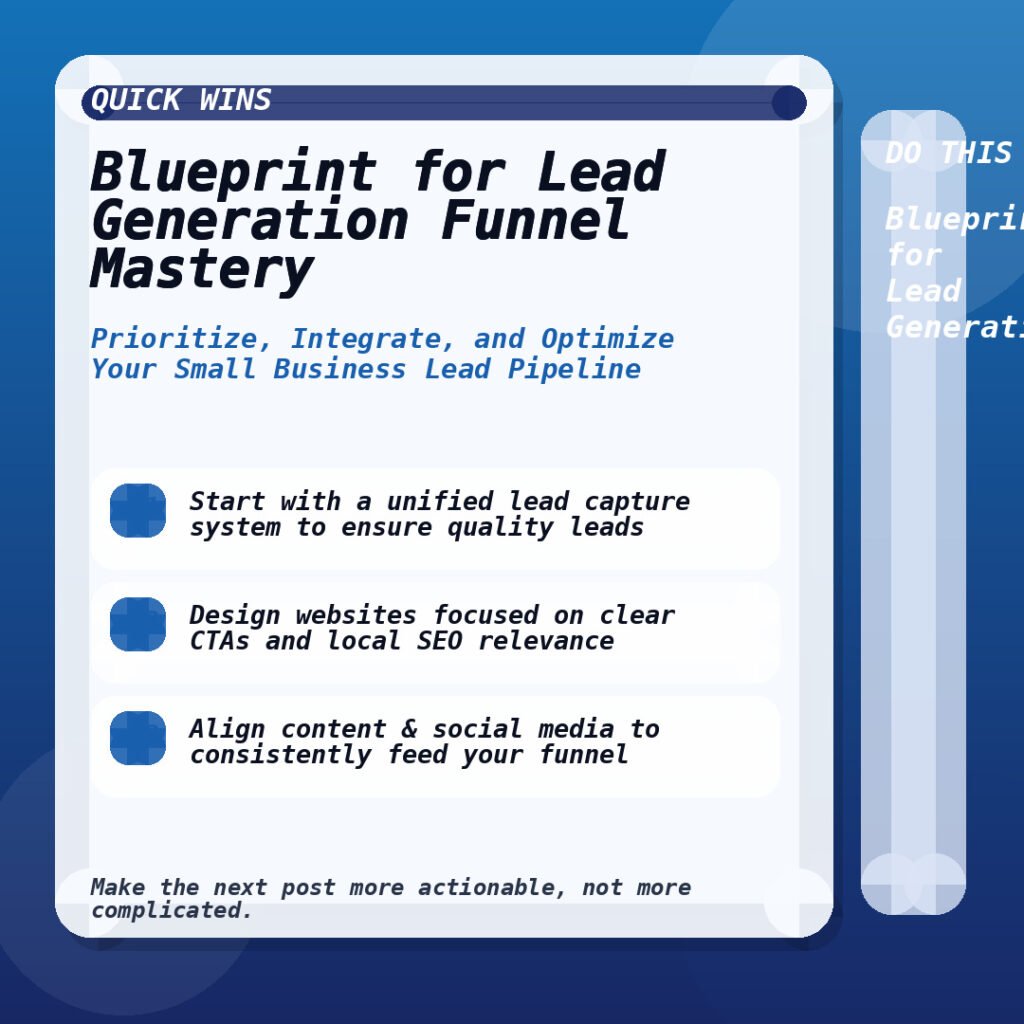
Your website must serve two masters: brand credibility and funnel effectiveness. WordPress paired with Elementor offers flexibility for business owners to craft tailored designs but beware:
- Overloading with unnecessary templates that don’t support critical lead capture points dilutes focus.
- Prioritize clear CTAs (calls to action) that guide prospects toward lead capture forms or offers.
- Use local SEO strategies to attract quality traffic relevant to your geographic market.
Implementation Mistake to Avoid
Relying too heavily on subscription website models or canned templates can alienate your audience and reduce trust if your site feels generic or difficult to navigate. Instead, opt for strategic customization aligned directly with your funnel’s objectives.
Crafting Content and Social Media Integration that Feeds Your Funnel
Social media isn’t just for engagement — it should feed your funnel constantly with qualified leads by driving targeted traffic.
- Develop content pillars aligned with your lead magnets and core offers.
- Use consistent hashtags and messaging that link back to your lead capture pages.
- Automate follow-ups or retargeting campaigns to pull warmer prospects deeper into the funnel.
Altflex’s guide on unifying content, lead capture, and follow-up illustrates how to operationalize this for small businesses effectively.
Trade-Offs in Lead Funnel Automation: What to Outsource, What to DIY
The decision between DIY marketing automation versus investing in professional support hinges on your internal capacity and urgency.
DIY Advantages:
- Control over every touchpoint.
- Lower upfront costs.
Professional Support Benefits:
- Expert design reduces costly mistakes.
- Strategic insights from proven workflows accelerate results.
Checklist: Deciding Your Automation Approach
- Do you have time to learn specialized tools like marketing CRMs?
- Is your team trained to manage and analyze lead data effectively?
- Can you afford the upfront investment for an outside expert?
Managing Your Lead Pipeline to Maximize Conversions
A lead generation funnel is only as good as its ongoing lead management. Implement proven pipeline management tactics:
- Regularly cleanse and segment your lead database.
- Implement scoring to prioritize outreach.
- Adjust communications based on lead behavior.
Altflex’s piece on four ways to manage lead pipelines distills actionable strategies specifically for small business constraints.
Step-By-Step Funnel Implementation Framework for Small Business Owners
- Map customer journey: Identify key decision points and data collection needs.
- Design unified lead capture pages: Use minimal but targeted forms.
- Integrate lead capture with CRM: Automate data flow and notifications.
- Develop content strategy: Align social media posts, blogs, and offers.
- Implement SEO: Specifically target local keywords relevant to your market.
- Test funnels incrementally: Use metrics to optimize conversion rates.
- Train or hire for lead management: Ensure timely and personalized follow-up.
Every step requires balancing clarity, resource allocation, and iterative improvement.
Building a lead generation funnel that truly works is a strategic journey, not a set-it-and-forget-it task. To reduce costly missteps and streamline your roadmap, consider exploring Altflex’s proven frameworks and resources designed precisely for serious business owners ready to scale effectively and sustainably.
Elevate your lead systems and watch your business pipeline fill smartly — start with a clear, prioritized plan today at Altflex.