
Lead generation funnels are the lifeblood of modern business growth, yet many owners struggle to translate theory into executable workflows that produce real-world outcomes. Too often, the challenge lies not in understanding the value of funnels, but in the overwhelming array of options, priorities, and technical trade-offs demanding a clear implementation path.
This guide dissects the lead generation funnel process into actionable steps while highlighting common pitfalls. You’ll gain clarity on where to focus your resources—whether on smart web design choices, marketing integration, or local SEO tweaks—so you can move beyond theory and build a system that consistently fills your pipeline with qualified prospects.
Defining Your Lead Generation Funnel Objectives Early
Before jumping into software and templates, business operators must anchor their work in unambiguous objectives—what kind of leads are you targeting, and what’s your definition of conversion success? Setting these benchmarks upfront reduces wasted effort and technology mismatches downstream.
- Identify your ideal customer profile with specificity
- Clarify the end goal: e.g., booking consults, e-commerce sales, or data capture
- Define quantitative metrics (conversion rate targets, cost per lead) to measure progress
This step forms the foundation of your entire funnel, reinforcing the strategic workflow in Altflex’s unified content and lead capture system approach.
Crafting Your Funnel Architecture: Prioritize Simplicity and Functionality
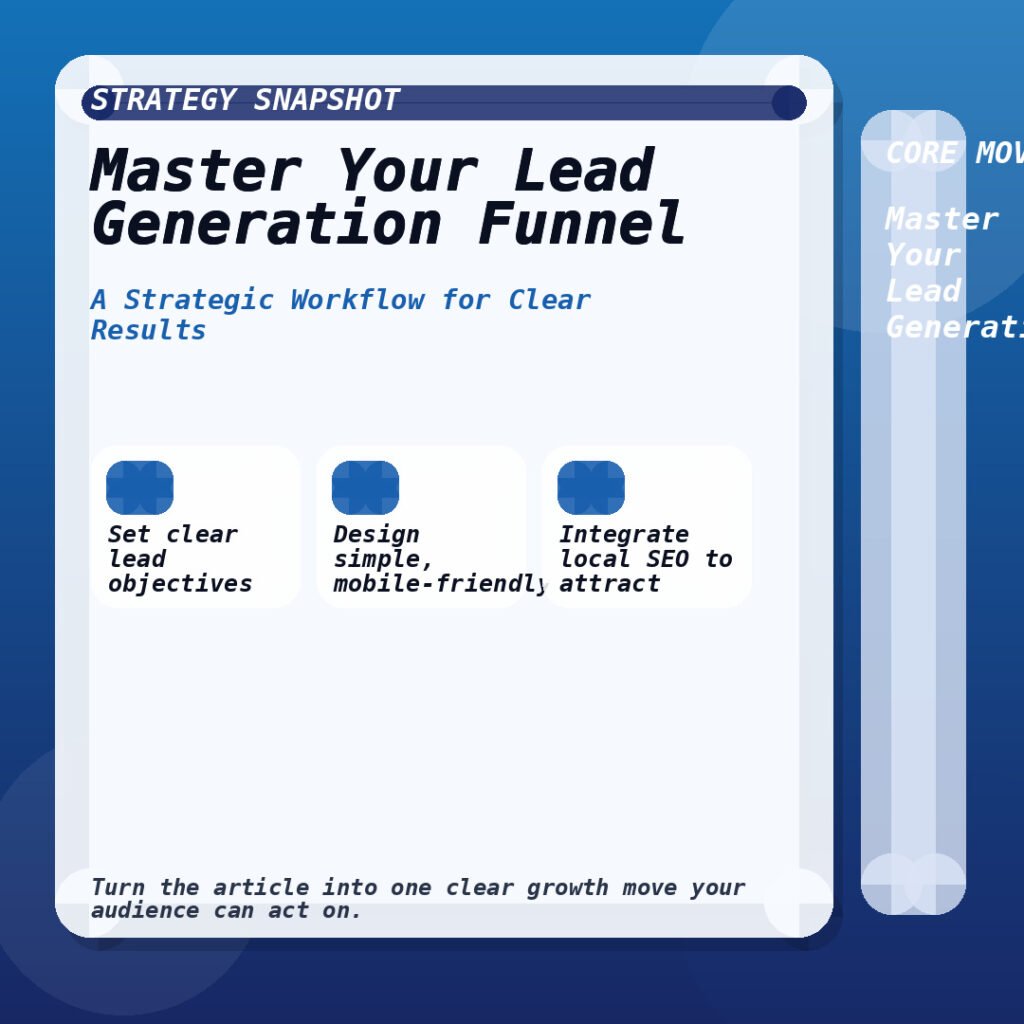
The design of your funnel should optimize intuitive lead flow while balancing technical complexity and ease of updates. Here’s where choices such as relying on WordPress combined with Elementor page builder come into play.
Essential Funnel Components
- Landing Pages: Optimized for conversion, fast loading, mobile-friendly
- Lead Capture Forms: Minimal fields to reduce friction; integrate with CRM tools
- Follow-Up Automation: Email sequences or retargeting paths to nurture prospects
Trade-offs to consider:
- Using website templates accelerates deployment but can limit customization
- Off-the-shelf WordPress plugins simplify forms but may add performance overhead
- Advanced funnel builders might add cost and learning curves versus DIY Elementor designs
Prioritize based on your team's skillset and budget. A lean funnel with reliable functionality often beats flashy, complicated setups that break or confuse visitors.
Integrating Local SEO Into Your Funnel for Targeted Traffic
For many businesses, especially in services or retail, local SEO is a pivotal lever to attract high-intent prospects. Incorporating local SEO tactics directly into your funnel pages boosts discoverability where it matters most.
- Select location-specific keywords and embed naturally in page content
- Use schema markup to signal business location and operating hours
- Ensure NAP (Name, Address, Phone) consistency across listings and your site
Well-optimized landing pages can capture search traffic organically, reducing reliance on paid campaigns. For a deeper dive into setting up a cohesive local marketing funnel, consult this specialist Altflex resource.
Practical Checklist: Lead Funnel Implementation Workflow
- Clarify Goals: Define target lead type and conversion criteria
- Select Platform: Choose your CMS, e.g., WordPress with Elementor
- Design Landing Pages: Use templates with conversion best practices
- Set Up Lead Capture: Integrate optimized forms and CRM connection
- Build Follow-Up Funnels: Develop automated nurturing workflows
- Optimize SEO: Embed local and primary keywords
- Test and Analyze: Run A/B tests, measure metrics, and iterate
Following this step sequence provides a roadmap that balances speed and precision, minimizing costly rework.
Managing Your Funnel and Lead Pipeline for Sustained Growth
Once live, the funnel’s success depends equally on continuous management. Lead volume and quality fluctuate, requiring dynamic attention to funnel mechanics and pipeline health.
- Monitor Lead Flow: Use dashboards to track drop-offs and conversion stages
- Refine Messaging: Adjust copy and calls to action based on analytics
- Prioritize Leads: Implement score-based segmentation for efficient follow-up
Altflex offers insightful strategies for optimizing lead pipeline management to maximize conversions, which may be useful for refining your post-capture tactics (learn more here).
Avoiding Common Missteps and Trade-Off Pitfalls
Many operators fall into predictable traps:
- Overloading Landing Pages: Too many options dilute focus and lower conversion
- Neglecting Mobile Optimization: A majority of traffic is mobile; slow or broken pages lose leads instantly
- Ignoring Data Integration: Siloed tools prevent holistic funnel insight
Be pragmatic: choose reliable technology stacks, enforce consistent brand messaging, and prioritize the user experience.
Building an effective lead generation funnel is a strategic discipline demanding clarity, discipline, and intelligent trade-off management. By following a structured workflow—from goal setting through ongoing pipeline management—you can transform your lead funnel from a theoretical concept into a precision tool for growth.
For business owners aiming to unify content, lead capture, and follow-up in a cohesive system, exploring Altflex’s comprehensive solutions is a smart next step to elevate your marketing infrastructure and ensure every lead counts.